Shamanism in Chinese Medicine
The first Chinese Medicine physicians were shamans. They were called Wu, and what they understood still sits underneath the medicine we practise today.
The first Chinese Medicine physicians were shamans. They were called Wu. They understood the workings of the universe, the flow of qi and the rhythms of the 5 Elements - Water, Wood, Fire, Earth & Metal, and they used this information to treat imbalances and educate people in how to live in accordance with Nature. Shamanism was the precursor to Classical Chinese Medicine and shamanism laid the building blocks for Daoism and Confucianism which is the philosophical framework which Chinese Medicine is build upon - They share deep historical roots.
Historical records differ from 8.000-50.000 years all depending on which sources you read, and scholars are in disagreement as to how long shamanism has been around, though archaeological findings from the Yangshao culture suggest that Daoist shamanism existed for over 8000 years.
There is a strong consensus that shamanism originated around Siberia, Mongolia and Northern China and around the Altai mountains and from there migrated to other parts of Asia. There was another branch of migration, journeying towards Alaska via the Bering Strait to the Americas all the way down to Peru and Chile where indigenous cultures to this day are still practising shamanic rituals.
Shamanic rituals vary from region to region but the common denominator regardless of location is that the main focus is upon Healing the Spirit.
Shamans look at Spirit/unseen consciousness as the primary reality and the physical world is secondary or an expression of Spirit.
Entering trance-states, soul retrieval, journeying, drumming, chanting, dancing were all ways to heal spirit. In South America there is an emphasis on plant medicine ceremonies which was my own entrance into the shamanic/unseen world and it was what laid the foundation for me to become a Hypnotherapist and practise Acupuncture and teach Chinese Medicine and Daoist philosophy through 5 Elements Wisdom Academy.
When I started studying Chinese Medicine and acupuncture it was based upon TCM (Traditional Chinese Medicine). This is somewhat misleading, as TCM was a medical system developed under the communist regime under Mao Zedong, taking flight during the disastrous Cultural Revolution he imposed on his people. Chinese Medicine was standardized to fit the western world view of materialism and was stripped of the spiritual/shamanic layer. The very essence of what Chinese Medicine used to be. The differentiation is thus:
- Traditional Chinese Medicine (TCM) – deprived of Spirit -focusing on qi, yin/yang, blood/ 5 Phases/Elements system and bodily functions – Material/physical.
- Classical Chinese Medicine – inclusive of Spirit – Originated from the Wu people – the shamans of old, included the above + the cosmic astrological forces, ancestral wounds, moral and karmic causes and could be addressed through ritual, ceremony and spirit consultation.
What we teach at The 5 Elements Wisdom Academy is rooted in Classical Chinese Medicine.
Classical Chinese Medicine uses symbolism to depict the essence of what shamanism is.
2 symbols illustrate the meaning of a shaman. The first one is:
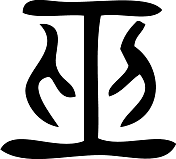
The above symbol depicts 2 people dancing or entering trance-like states to invoke spirit to enter the human realm for healing.
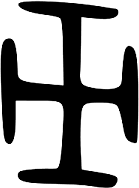
The second symbol depicts the 4 directions with the shaman in the centre, symbolising a person who is in total communion with the natural world. The centre in the old scriptures was the Element of Earth (the human body) and it is what inspired the logo of The 5 Elements Wisdom Academy below
I am immensely grateful for the formal modern medical training I received in Traditional Chinese Medicine (TCM) and my internships in Chengdu and Beijing University Hospitals in China, which provided me with a solid foundation for my clinical work. That being said, if we don’t incorporate Spirit as a factor for imbalances we are only touching on parts of the medicine and not inviting in the whole of the cosmos. The seen and the unseen world.
My 4 trips and 2 years to the Andes mountains of Peru with shamans and wisdom keepers and my initiation into The Inca Tradition with High Priest Javier Benino in my early twenties, gave me an intimate realisation of the spirit world, the cosmos and the ever vibrating natural world and is what laid the foundation to my spiritual path.
The word shaman today comes with a lot of baggage, for some considered controversial, some envision a charlatan with a silky voice throwing mantras around with no formal training, for some a god-like figure holding powers over others introducing mystical ways of healing.
Our school´s approach is to take that out of the equation. Bringing it down-to-earth. Bridging Heaven and Earth, keeping it real, while acknowledging a medicine that is rooted in Spirit.
The Daoist Shaman world view consist of:
- The inner cultivation of our relationship with the Dao – Unity
- Our relation with Yin/Yang dynamic forces of the Universe - Duality
- The 3 Treasures of Jing/Qi/Shen – The physical, emotional and spiritual
- The fluctuating forces of The 5 Elements Of Nature
- An understanding of our physical body and its energetic pathways/meridian lines.
Daoist Shamanic based treatments can consist of:
- Drum Healing
- Qi Gong
- Talismans
- Chanting/Mantras/Invocations
- Feng Shui
- Herbal Medicine
- Acupuncture
- Blood Letting
- Cupping
Diagnostic tools:
- Face Reading
- Pulse Reading
- Tongue Reading
- Channel Palpation
- Astrology
- Divination through consultation of the Yijing
The Yijing – “Wu shu” (The Shaman´s Book) is another fascinating aspect of Classical Chinese Medicine. It is a book written by King Wen, Zhou Dynasty around 9th century BCE. and categorizes both the concept and process of change. It mapped out 8 trigrams, each trigram representing an aspect of the natural world. Heaven, Earth, Thunder, Water, Mountain, Wind, Fire and Lake.
The Yijing has been used for centuries to awaken intuition and for divination purposes. We can use it to consult it in all matters of life. Originally people consulted it by casting yarrow stalks but in today´s world a more suitable approach would be to use coins.
An interesting fact is that psychiatrist Carl Jung, the “father” of modern analytical psychology, used the Yijing (I Ching) for consultation. He mentions the concept of “meaningful coincidences”. Another word for that would be “synchronicity.” To invite in synchronicity and to develop his intuition he would consult the Yijing.
If on a conscious or subconscious level, the Yijing intrigues you, the go-to book I recommend is: The I Ching – Book of Changes translated by Richard Wilhelm.
Sun Si Miao - The King Of Medicine from the 6th century Tang Dynasty would go as far as to say “Nobody qualifies to be a master physician without knowledge of the Yijing”.
Sun stressed the need to acquire knowledge both of the medical classics and shamanism, stating that a physician without knowledge of shamanism was a man who “sightlessly wandered in the night stumbling each step of the way”.
If you feel inspired to read one of the classics, The Huangdi Neiijing -The Yellow Emperor´s Inner Classic is a deep one. It is the foundational text of Chinese Medicine – The oldest medical book known, written around 2nd century B.C. It is a dialogue between The Yellow Emperor and his chief physician Bo on all matters of existence. It splits into 2 parts: The Suwen “Basic Questions” and the Ling Shu “Spiritual Pivot”.
Demons, Ghosts and Evil Qi in Chinese Medicine
Sometimes I get questions from students or clients around this topic. When I give them my answer – Their shoulders drop.
We should consider them metaphors for energy tampering with our internal environment.
the “evils” are related to external wind and the pathology created in the body could result from changes in the environment. Illness can be a result of being out of sync with the seasons, the movement of the moon and the rhythms of Nature.
“Demon energy” or evil qi relates to all kinds of addictions, trapped and stuck emotions. I like to say that there are no wrong emotions, only the trapped ones.
“Ghostly energy” is what we in the West would frame as generational trauma. The trauma that is passed down from generation to generation.
For these disharmonies to stop affecting our health we need to transform them. No need to trap them, zeal them in a glass jar or annihilate them with a physical sword – They need to be transformed. A fire ceremony can be a beautiful way to release old patterns, where we give back to the fire what no longer serves us.
The shamans would say “come in to right relation with Nature, the cycles and the cosmos so illness will have no place to anchor in your body”.
This is why we created 5 Elements Wisdom Academy. To offer a “road map” for students to come into right relation with Nature and ultimately ourselves.
We fuse Yin Yoga with the concepts and ideas of the ancient masters of Classical Chinese Medicine to bring balance and harmony into the equation of what it means to be truly human.
Maybe its time to change the phrase “behind every great man, there´s a great woman” to “Behind every great woman is a great “Wu-man”
Our advanced Yin Yoga Chinese Medicine Teacher Training could be your gateway. To join our community and take the next step in the stewardship of our beautiful and magnificent planet. Our Pachamama.
Yin Yoga & Chinese Medicine Training →
With love and appreciation,
Tobias Tang
5 Elements Wisdom Academy